
New Mexico in winter is not one climate. It is a high-low desert contrast compressed into a single trip: alpine cold and snow in the north, bright high-desert days in Albuquerque and Santa Fe, and comparatively mild afternoons at White Sands. The official Albuquerque visitor bureau reports 310 days of sunshine, while Santa Fe tourism reports more than 320 and describes the city’s winter as “a dry cold.” Sunshine is common; warmth is not guaranteed.
The main wet season is the summer monsoon, so winter sits outside New Mexico’s principal rainy period. Winter storms still occur, and elevation changes their effect. White Sands averages a December high near 60°F and low near 23°F. Bandelier averages about 39°F/20°F in December and roughly 11 inches of snow in each month from December through February. At the alpine end, the Village of Taos Ski Valley sits at 10,388 feet and reports a January low of 4°F. A useful winter itinerary plans for all three versions of the state rather than packing for a single forecast.
Winter temperatures by elevation
New Mexico’s winter temperature depends far more on elevation than on latitude. The state runs from southern lowland desert to peaks above 12,000 feet, so a single statewide number is misleading. The New Mexico altitude guide carries a comparison table for the state’s major elevation changes.
How cold does it get in New Mexico in the winter time?
Winter can bring freezing nights even where afternoons are comparatively mild, while the northern high country is colder. As a rough December guide, approximate typical highs and lows are around 48°F and 23°F in Albuquerque, 41°F and 19°F in Santa Fe, and 56°F and 37°F in Las Cruces. These are approximate typical figures, not official published normals. Use the National Weather Service for the forecast and official climate data.
How warm is it in New Mexico in December?
Approximate typical December highs are around 48°F in Albuquerque, 41°F in Santa Fe, and 56°F in Las Cruces. Approximate lows are around 23°F, 19°F, and 37°F, respectively. These figures are a rough guide rather than official published normals, and the forecast for a particular place and date can differ.
What part of New Mexico has the warmest winters?
The southern lowlands around Las Cruces and the Carlsbad area generally have New Mexico’s warmest winters. The northern high country around Santa Fe and Taos is colder because it sits higher, not simply because it is farther north. Elevation is the main reason one part of the state can have a mild afternoon while another remains in alpine winter.
Ski country
The statewide New Mexico Ski Resorts overview covers nine downhill areas, but their operating patterns are not interchangeable. Taos Ski Valley, Ski Santa Fe, and Ski Apache form the first group of detailed mountain guides. Sipapu Ski & Summer Resort, Angel Fire Resort, Red River Ski + Summer Area, and Sandia Peak Ski Area add four distinct planning choices. Pajarito Mountain and Ski Cloudcroft complete the statewide roster.
Sipapu’s family-oriented base on NM-518 has a history of early openings, yet it closed early in late March 2026 during an unusually warm, low-snow winter. Angel Fire combines 560 acres with family facilities and what the resort calls New Mexico’s only night skiing; its evening schedule changes by season and weather. Red River is the most town-integrated option in this group, with lifts rising from a community where Main Street doubles as a ski run. Sandia Peak is the status-sensitive choice: its 2025-26 operation began only around January 11-12, 2026 and paused after February 16, leaving roughly five weeks of skiing.
That range makes “ski season” a planning category, not a statewide promise. Check each resort’s dated calendar and mountain report, then check NMRoads for the specific approach. A pass affiliation does not establish that a lift will run, and an announced closing date can move when warmth or snow coverage changes.
Winter at the parks
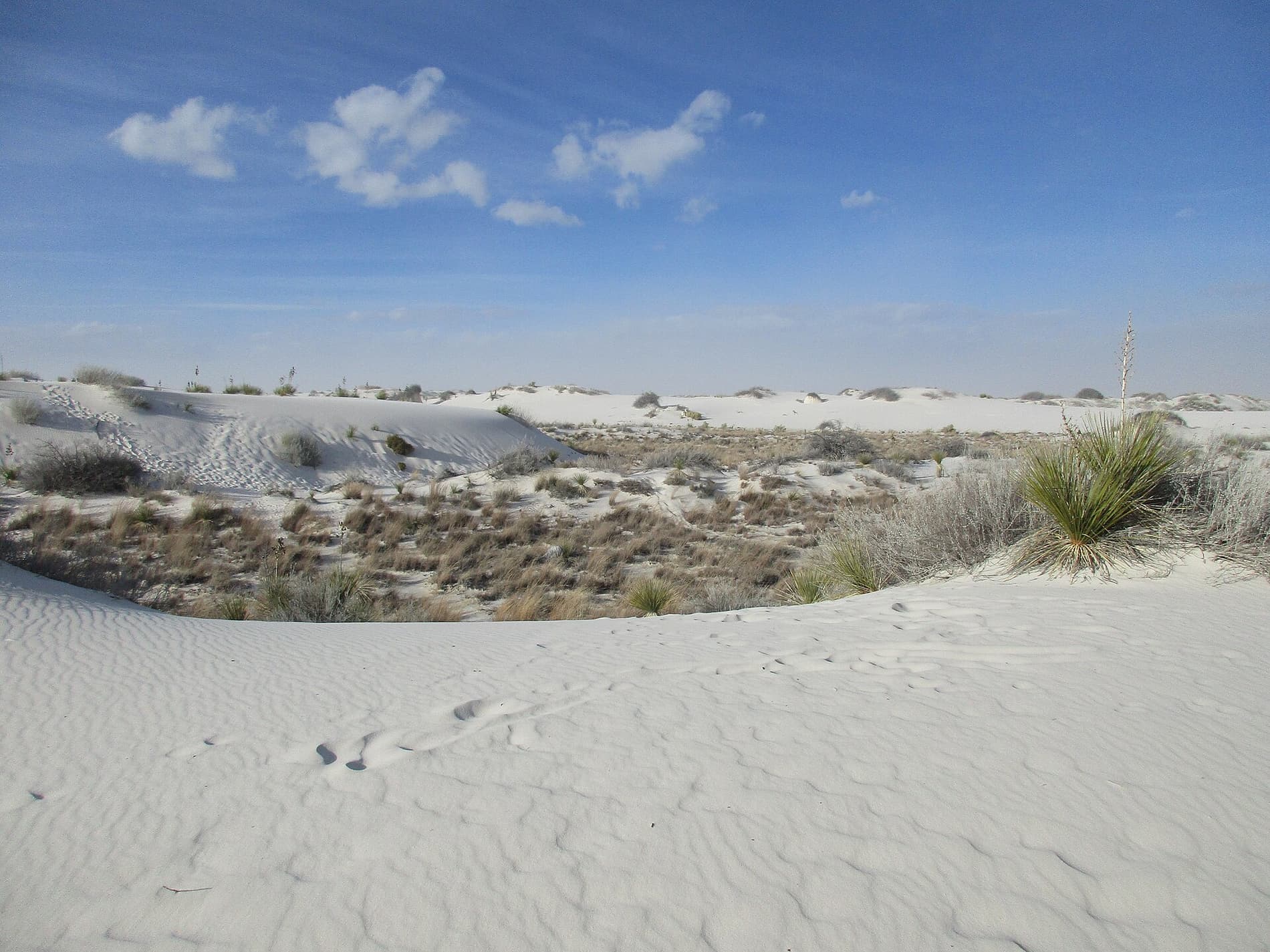
White Sands National Park is open daily year-round except Thanksgiving and Christmas, although hours change seasonally. Missile tests can also cause temporary closures of roughly three hours. Winter afternoons are often mild by mountain standards, with December averaging about 60°F during the day, but nights average near 23°F. January averages 57°F/22°F and February 63°F/27°F. The National Park Service says an occasional winter storm can bring rain and limited snow, so the white landscape should not be mistaken for a warm one after sunset.
Sledding on the gypsum dunes is permitted year-round. The Park Service says waxed plastic snow saucers work best and notes that they can be rented or purchased at the park gift shop. Sledding is not allowed at the Interdune Boardwalk. Current hours and any missile-range closure should be checked before the drive.
Carlsbad Caverns offers the opposite kind of weather hedge: the Big Room averages 56°F, making the cave similar in January and July. Surface weather can still affect the trip, and entry procedures remain time-sensitive. The checked park page listed a final cavern entry at 2:30 p.m. and required natural-entrance hikers to be out by 3:30 p.m., but hours are volatile and should be verified. The park closes on Thanksgiving, Christmas, and New Year’s Day, and timed-entry reservations through Recreation.gov are strongly recommended.
Bandelier National Monument has a real mountain winter. It is generally open dawn to dusk except Christmas and days with heavy snow. December averages about 39°F/20°F, and the park reports around 11 inches of snow monthly from December through February. That is a different packing and driving problem from White Sands on the same trip.
Kasha-Katuwe Tent Rocks has the clearest calendar restriction: it closes annually from December 15 through January 31. Outside that closure, access is reservation-only Thursday through Monday from 8 a.m. to 1 p.m. and requires a Cochiti Pueblo Tribal Access Pass. Winter trails can be icy. A reservation should never be assumed to override the annual closure.
Sandhill cranes at Bosque del Apache
Bosque del Apache National Wildlife Refuge lies along the Rio Grande in Socorro County, south of Socorro near San Antonio. The U.S. Fish and Wildlife Service says tens of thousands of cranes, geese, and ducks winter there. First arrivals begin near the end of October, with the greatest numbers from early November through late January. By February, numbers are already declining.
Dawn fly-out and evening fly-in are the main daily spectacles, so a visit works differently from a midday scenic stop. The 37th Festival of the Cranes is scheduled for December 2-5, 2026 according to Friends of Bosque del Apache. That is a dated 2026 event, while the broader early-November-to-late-January window comes from the refuge and is the better starting point for a non-festival trip.
Holiday season
Santa Fe’s Canyon Road Farolito Walk takes place every Christmas Eve from sundown. A farolito is a paper bag weighted with sand and lit by a votive candle. New Mexico Tourism explains the regional language: north of La Bajada Hill, including Santa Fe and Taos, “farolito” is customary, while “luminaria” is common from La Bajada south, including Albuquerque. In northern usage, luminaria properly names a small bonfire. The distinction is regional, not a reason to correct a community’s own event name.
Albuquerque’s River of Lights at the ABQ BioPark Botanic Garden describes itself as New Mexico’s largest walk-through holiday light show, with more than 700 displays along a 1.6-mile path. The 2025 event ran November 29 through December 30 and closed December 24-25. Dates for 2026 had not been announced by July 21, so the responsible planning language is “typically late November through December,” followed by a check of the current event page.
Hot springs in winter
Truth or Consequences has a walkable historic district built around ten commercial bathhouses above a 100-115°F aquifer; most offer hourly walk-in soaking, and the town itself was named Hot Springs until 1950. Jemez Springs has a more-than-century-old, village-owned Bath House that is a State Historical Site, while nearby primitive springs sit on public land with sunrise-to-sunset day use, no facilities, and potentially icy winter trails. Ojo Caliente, about 50 miles north of Santa Fe, is described by New Mexico Tourism as one of the oldest health resorts in North America. These are three different experiences: a commercial district, a village bathhouse plus primitive sites, and a resort. Each requires its own current access check.
Stargazing in winter
Longer winter nights create more dark hours before midnight. New Mexico Tourism connects the state’s stargazing strength to high elevation, low population, and dry climate. The New Mexico DarkSky chapter lists nine certified Dark Sky places: Capulin Volcano, Clayton Lake, Cosmic Campground, Chaco Culture, Fort Union, Salinas Pueblo Missions, Valles Caldera, El Morro, and Valle de Oro.
Their designations are not all the same. Capulin Volcano received Gold-Tier recognition in 2016 according to the National Park Service. Clayton Lake was New Mexico’s first dark-sky park, while Cosmic Campground is an International Dark Sky Sanctuary. Certification does not establish a winter program, an open road, or overnight access. Choose a place from the official designation list, then verify that site’s current hours and conditions separately.
Practical winter notes
Start every driving day with NMRoads.com, the state’s official road-advisory system, or dial 511 within New Mexico. NMDOT advises slowing down, never using cruise control on ice, staying at least five car lengths behind a snowplow, carrying chains and a winter survival kit, and keeping the fuel tank full. Those are statewide preparations; a resort or park may publish additional road-specific instructions.
Elevation should shape the itinerary as much as mileage. Albuquerque is already above 5,000 feet, Red River’s town and ski base sit at 8,750 feet, and the Village of Taos Ski Valley is at 10,388 feet. Red River’s visitor guidance says the altitude can take a day or two to get used to. Avoid treating a short map distance as a small physical change, particularly when traveling from the southern desert to the northern mountains.
Pack layers for the documented temperature spread. A day can begin near the low 20s at White Sands or Albuquerque even when the afternoon approaches the upper 40s or 50s; Bandelier and ski country can remain colder and snowier. Recheck park hours, road alerts, resort status, and event dates close to travel. New Mexico’s winter advantage is variety, but that same variety makes a single statewide weather assumption unreliable.