
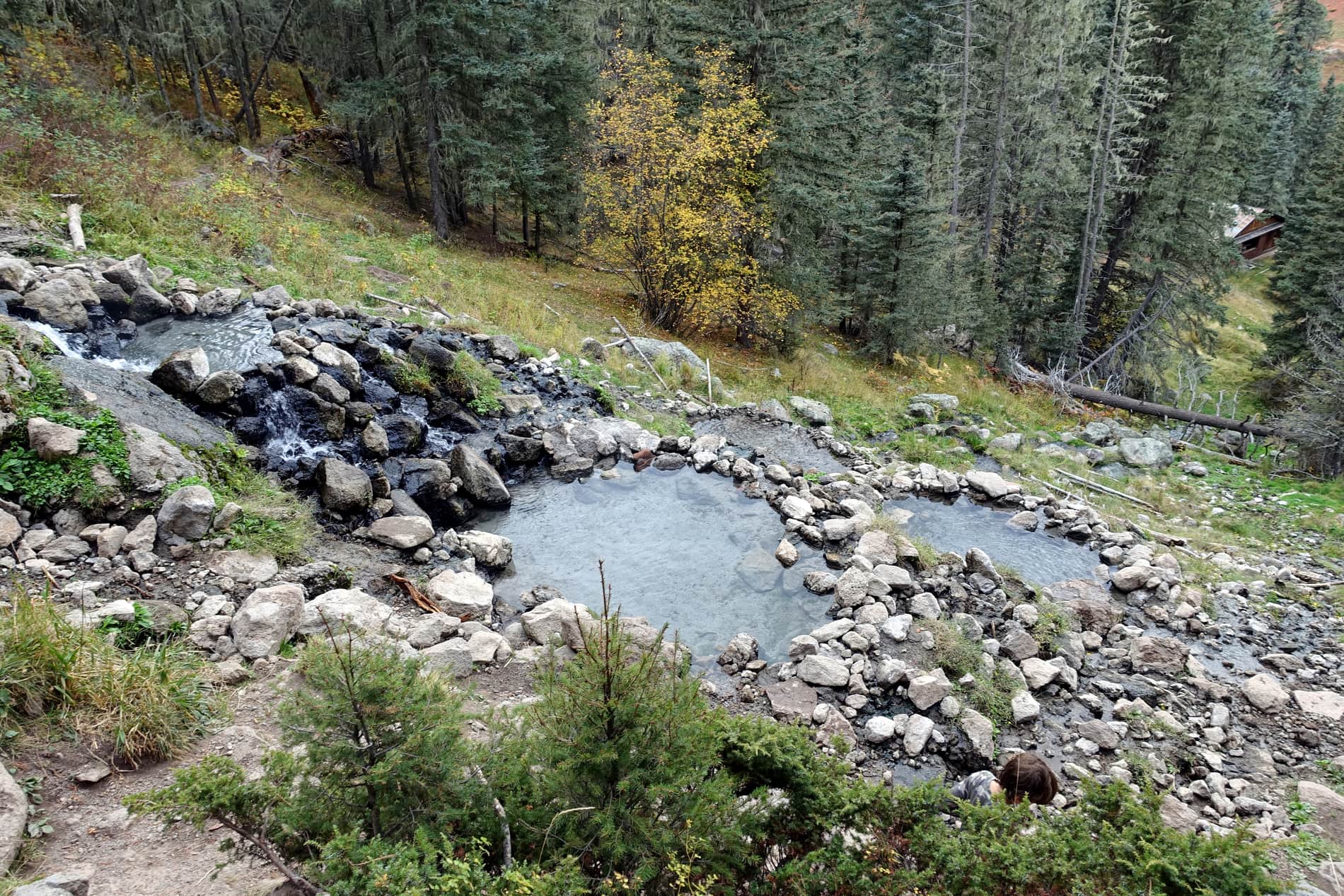
What makes New Mexico geothermal country
Official descriptions show geothermal water reaching developed pools in several different ways. Truth or Consequences sits above a low-temperature geothermal aquifer. Riverbend says it pumps mineral-rich water from deep within the earth. Faywood says water flows from the top of a tufa mound into developed soaking areas. Ojo Caliente describes nine public pools naturally enriched with iron, lithia, arsenic, and soda.
Those systems produce a statewide soaking map that is not one uniform experience. Some water is delivered into resort pools and private tubs. Other springs emerge along forest trails, hillsides, or the Rio Grande, where access and water conditions can change the plan.
Developed resorts and primitive springs
Developed soaking includes the bathhouse district in Truth or Consequences, Jemez Hot Springs in Jemez Springs village, Ojo Caliente, Riverbend, and Faywood. Operators control admission, publish hours and rules, and maintain the soaking areas. Natural geothermal water can still feed a developed facility.
Primitive springs have little or no on-site management. Spence and San Antonio are forest sites. Black Rock and Manby are undeveloped riverside springs on BLM land. Lightfeather and Jordan are reached through the Gila trail system. Water quality is unmonitored at primitive springs, so access and health precautions are part of the visit.
Prices, temperatures, and hours are deliberately left out of the statewide table. Check the official page before travel. Any operating detail stated elsewhere on this page is dated to July 2026.
| Name | Style | Managing agency or operator | Nearest town | Official page |
|---|---|---|---|---|
| Truth or Consequences Bathhouse District | Developed | Privately operated bathhouses and resorts | Truth or Consequences | County visitor page |
| Jemez Hot Springs | Developed | Home of the Giggling Springs | Jemez Springs | Operator page |
| Spence Hot Spring | Primitive | Santa Fe National Forest | Jemez Springs | Forest Service page |
| San Antonio Hot Springs | Primitive | Santa Fe National Forest | Not stated on the official page | Forest Service page |
| McCauley Warm Springs | Primitive | Santa Fe National Forest | Not stated on the official page | Forest alerts |
| Black Rock Hot Springs | Primitive | Bureau of Land Management | Arroyo Hondo | BLM monument page |
| Manby or Stagecoach Hot Springs | Primitive | Bureau of Land Management | Not stated by BLM | BLM monument page |
| Ojo Caliente Mineral Springs Resort and Spa | Developed | Ojo Caliente Mineral Springs Resort and Spa | Not stated on the official soaking page | Operator page |
| Montezuma Hot Springs | Primitive | Friends of the Montezuma Hot Springs on United World College land | Las Vegas | Official visitor page |
Truth or Consequences bathhouse district
Truth or Consequences is the statewide anchor for soaking in town. Its historic Bathhouse District concentrates privately operated hotels, spas, and bathhouses above a low-temperature geothermal aquifer. The county tourism office describes the mineral water as sulfur-free and without an unpleasant odor.
This is the developed end of the spectrum. Piped or pumped water fills maintained tubs, and individual operators set reservation, guest, age, and admission rules. Commercial tubs are a different setting from unmonitored wild pools, so the primitive-spring amoeba caution is less directly applicable.
Jemez Springs and the forest corridor
Spence Hot Spring is a day-use site with no fee. The Forest Service lists it as open year-round, and it reopened by July 9, 2026 after the McCauley Springs Fire. Its water quality is not monitored. Glass, camping, and campfires are prohibited, dogs must be leashed, and poison ivy grows along the trail.
San Antonio has primitive rock-lined hillside pools reached by about 0.7 mile of trail from the Forest Road 376 trailhead. The site is listed as open, but FR 376 is seasonally gated. When the gate is closed, reaching the trailhead can require a walk or bike trip of about five miles each way. Seasonal road closures generally run from December through May, and wildlife closures can also restrict motorized access.
McCauley Warm Springs remained closed under the McCauley Springs Fire area closure as of July 24, 2026. The closure was scheduled to remain in effect until August 11, but that date is not a reopening promise. Check current Santa Fe National Forest alerts before planning the route.
Jemez Hot Springs provides the commercial alternative in Jemez Springs village. As of July 2026, the operator accepted walk-ins only, admitted guests age 14 and older, and offered one-hour and two-hour sessions. Check the current rates and hours page rather than relying on those policies beyond the stated date.
Taos-area riverside springs
Black Rock and Manby, also called Stagecoach, are undeveloped springs in the Rio Grande gorge within Rio Grande del Norte National Monument. BLM does not publish dedicated pages for either spring. River levels can flood or submerge the pools, especially during high flow and spring runoff.
Black Rock sits on the west bank of the Rio Grande near the John Dunn Bridge by Arroyo Hondo. Do not rely on an unofficial temperature figure. For Manby, do not improvise an overland route or cross private property. Ask the BLM Taos Field Office for current legal access and keep route planning general.
Ojo Caliente
Ojo Caliente was operating as of July 2026. The resort describes nine public mineral soaking pools with four distinct minerals: iron, lithia, arsenic, and soda. General soaking was first come, first served, while private soaks were arranged by phone.
This is a developed resort visit, not a primitive pool. Current day-pass prices, hours, and private-soak arrangements belong on the operator page because they can change.
Gila-area springs
Gila Hot Springs is a private campground about 40 miles north of Silver City near Gila Cliff Dwellings. It has three man-made, spring-fed pools. Rates and hours were not confirmed, so contact the operator before relying on day use or camping.
Lightfeather is reached from the Gila Visitor Center by roughly 0.5 to 0.7 mile on Middle Fork Trail 157. The source runs scalding. The trail page listed Trail 157 as open year-round when updated in February 2026, but live alerts control.
Jordan Hot Springs requires roughly seven miles of travel through Little Bear Canyon Trail 729 and Middle Fork Trail 157, with many river crossings. High water and flash-flood conditions can make that route unsuitable.
As of late July 2026, the Gila Wilderness had a Sacaton Fire closure around Sacaton Mountain. Forest-wide fire restrictions had been rescinded July 20, while Ben Lilly and Willow Creek campgrounds were closed July 21 through October 16 for flood damage. Check the live Gila National Forest alerts page before either primitive route.
Montezuma Hot Springs
Montezuma has free public soaking pools on Armand Hammer United World College land near Las Vegas. Friends of the Montezuma Hot Springs manages the site. As of July 2026, posted hours were 6 am to 10 pm, and entering after hours was trespassing on private property.
Posted rules prohibit drugs, alcohol, smoking, nude bathing, glass, pets, and adding anything to the water. Donation boxes support the site.
Safety at primitive springs
Water quality is unmonitored at primitive springs. The Forest Service warns at Spence that visitors should avoid getting water in the nose because of the potentially fatal amoeba Naegleria fowleri. Keep the head above water, hold the nose or use a nose clip, and avoid stirring sediment. Infection occurs through nasal entry, not from drinking the water or from another person.
Leave glass behind at every spring. At riverside pools, watch river levels and flash-flood conditions. In winter and spring, confirm road gates before assuming a short trail becomes a short outing. Respect private-property lines and posted hours, especially around Manby and Montezuma.
Choosing the best fit
Choose by operating model before choosing by name. A maintained resort or bathhouse provides published admission rules and controlled pools. A primitive spring exchanges that structure for uncertain water quality, weather exposure, changing roads, and land-boundary responsibility.
For Taos-area springs, start with BLM. For the Jemez corridor, start with Santa Fe National Forest alerts. For the Gila, check forest alerts and river conditions. For every commercial property, check the operator page for current admission, age, clothing, and reservation policies.