
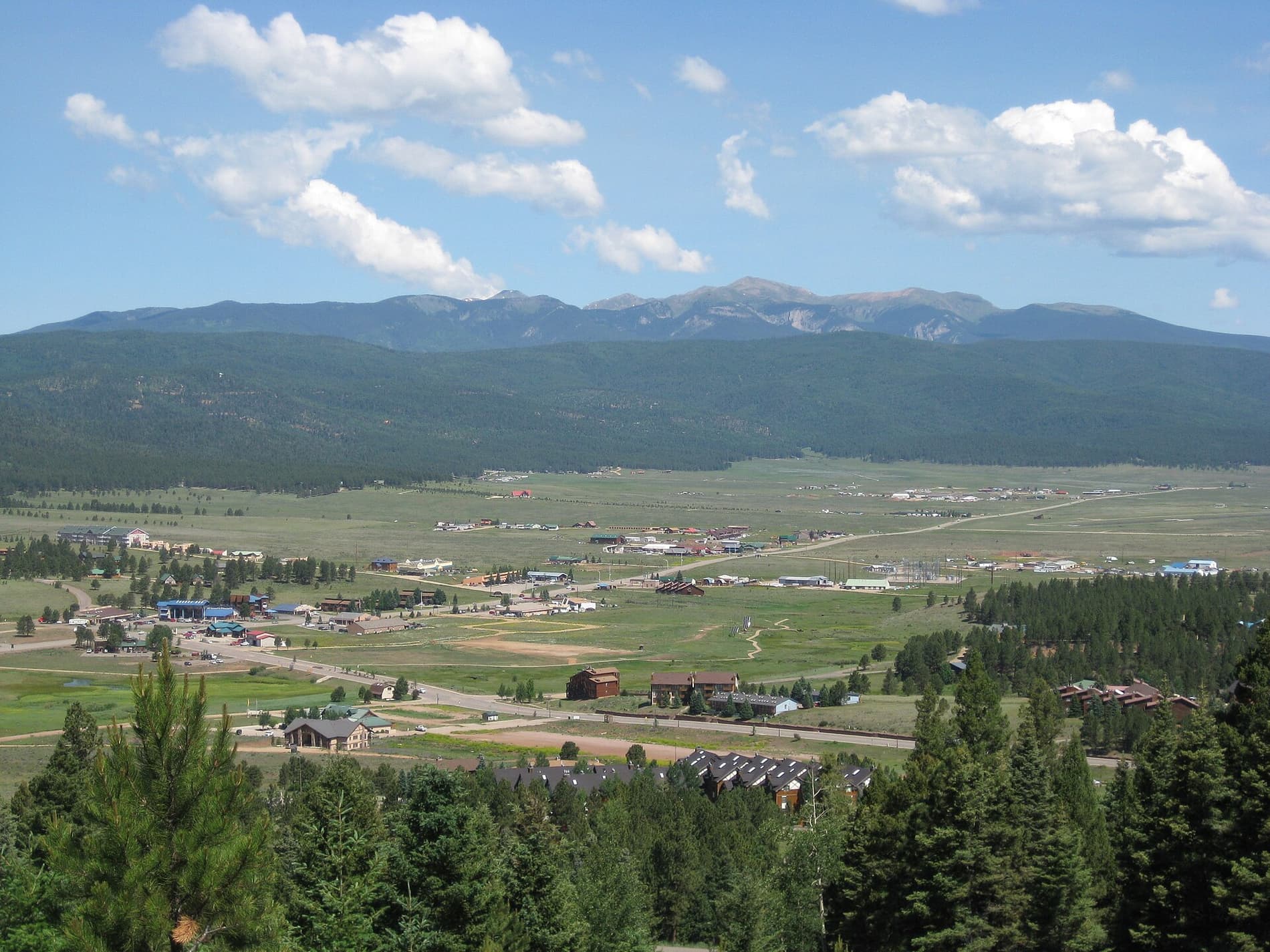
The mountain
Angel Fire Resort rises from an 8,600-foot ski base in the Moreno Valley to a 10,677-foot summit. That produces 2,077 feet of vertical across more than 560 skiable acres. The official mountain-statistics page lists 95 trails and eight lifts for 2025–26: two high-speed quads, one fixed-grip quad, three doubles, and two Sunkid Wondercarpets.
The terrain breakdown is 22% easier, 49% more difficult, 25% most difficult, and 4% extra caution. For the summary panel, the last two categories are combined as 29% advanced and extra-caution terrain. Nearly half the mountain sits in the intermediate category, while the beginner network includes Heading Home, a signature run extending more than 3.5 miles. Snowmaking covers 52% of the mountain and 85% of beginner terrain. Average annual snowfall is 210 inches.
The three terrain parks are Liberation at the summit, Sweet Street, and Tank 9; six named glade areas total another 40 acres. The Rakes Rider lift joined the network in 2025–26, with a 3,193-foot slope length and 932 feet of rise. It is named for Dan Rakes, an employee of more than 40 years. A high-capacity Angel Express lift was planned for a summer 2026 opening as of the July 21, 2026 check; “planned” is the appropriate status until the resort confirms completion.
Angel Fire’s defining winter difference is after-dark access. The resort calls its operation the only night skiing in New Mexico. For 2025–26, more than 50 acres of groomed front-side trails were scheduled on Fridays, Saturdays, and selected weekdays from 4 to 7 p.m., weather and conditions permitting. That calendar is season-specific, not a standing promise for 2026–27.
Getting there
Angel Fire is in the Moreno Valley, with Wheeler Peak nearby. The Village of Angel Fire describes the community as about half an hour east of Taos. The resort publishes broader estimates of about three hours from Albuquerque and one and a half hours from Santa Fe. Those are planning references rather than winter guarantees.
The road approach crosses US-64 over Palo Flechado Pass and turns onto NM-434 into Angel Fire. Neither the resort nor the village publishes a universal chain or four-wheel-drive requirement. Travelers should not invent one; they should check NMRoads or the state’s Roads Advisory Hotline at 800-432-4269 for current conditions.
Angel Fire Airport is three miles from the resort. The resort travel pages identify Albuquerque, Santa Fe, and Taos airports as the commercial options, without transfer schedules or promised connections. Anyone flying should arrange the ground segment separately and account for the mountain road.
Season & conditions
The 2025–26 ski season opened Friday, December 12, 2025 and closed March 22, 2026. No dates for 2026–27 had been announced as of July 21, 2026. A past season range is useful context, but it should not be copied forward as a forecast.
Normal lift hours were 9 a.m. to 4 p.m. on the resort 2025-26 winter pages. Night operations used a separate 4–7 p.m. window, and tickets were sold from 2 p.m. at the base ticket office rather than online. Every part of that night schedule was tied to the 2025–26 calendar and remained weather-dependent, so the current operating page should decide whether an evening plan is possible.
Snowmaking across most beginner terrain can support early-season learning areas, but 52% mountain coverage is not a promise that half the terrain will always be open. Natural snowfall, temperature, grooming, and lift operations still determine the usable mountain on a particular day.
Which is better, Taos or Angel Fire?
Taos Ski Valley has 3,131 feet of vertical, 1,294 acres, and 13 lifts. Angel Fire has 2,077 feet of vertical, 560 acres, and eight lifts. Taos is the larger mountain by those figures.
Angel Fire’s differences include night skiing and a beginner-friendly mix with 22% easier terrain, 49% intermediate terrain, and snowmaking across 85% of beginner terrain. Taos suits a trip centered on a larger mountain and more vertical. Angel Fire suits a trip that places weight on night skiing and beginner-friendly terrain. The choice depends on the trip.
Know before you go
Angel Fire began in 1966 and presents itself as a relaxed, family-friendly resort with wide-open terrain and short lift lines. The facts supporting that family character include carpets, a long beginner trail, a four-lane tubing hill, and a Nordic Center with more than 12 kilometers of groomed classic and skate terrain. Snowshoeing is allowed there, and a sledding hill is reserved for children 12 and younger. Each activity has its own conditions and schedule.
The Lodge at Angel Fire Resort has more than 100 rooms and is described by the resort as the only hotel directly next to the ski lifts. That can remove a daily road segment, but this guide does not infer package inclusions or availability. Angel Fire sells its own age-tiered passes and provides a military discount that includes dependents. Qualifying passholders also receive Powder Alliance benefits: three non-transferable tickets at partner resorts, with blackout dates. The partner list and terms are volatile.
One nearby stop is the Angel Fire Vietnam Veterans Memorial, operated by the New Mexico Department of Veterans Services since 2017. It is not a state park. The department describes it as the first major memorial created to honor Vietnam War veterans and notes its congressional recognition as a memorial of national significance. The site includes a visitor center and Huey display. It is a separate destination from the resort and should be planned on its own current hours.