
The mountain
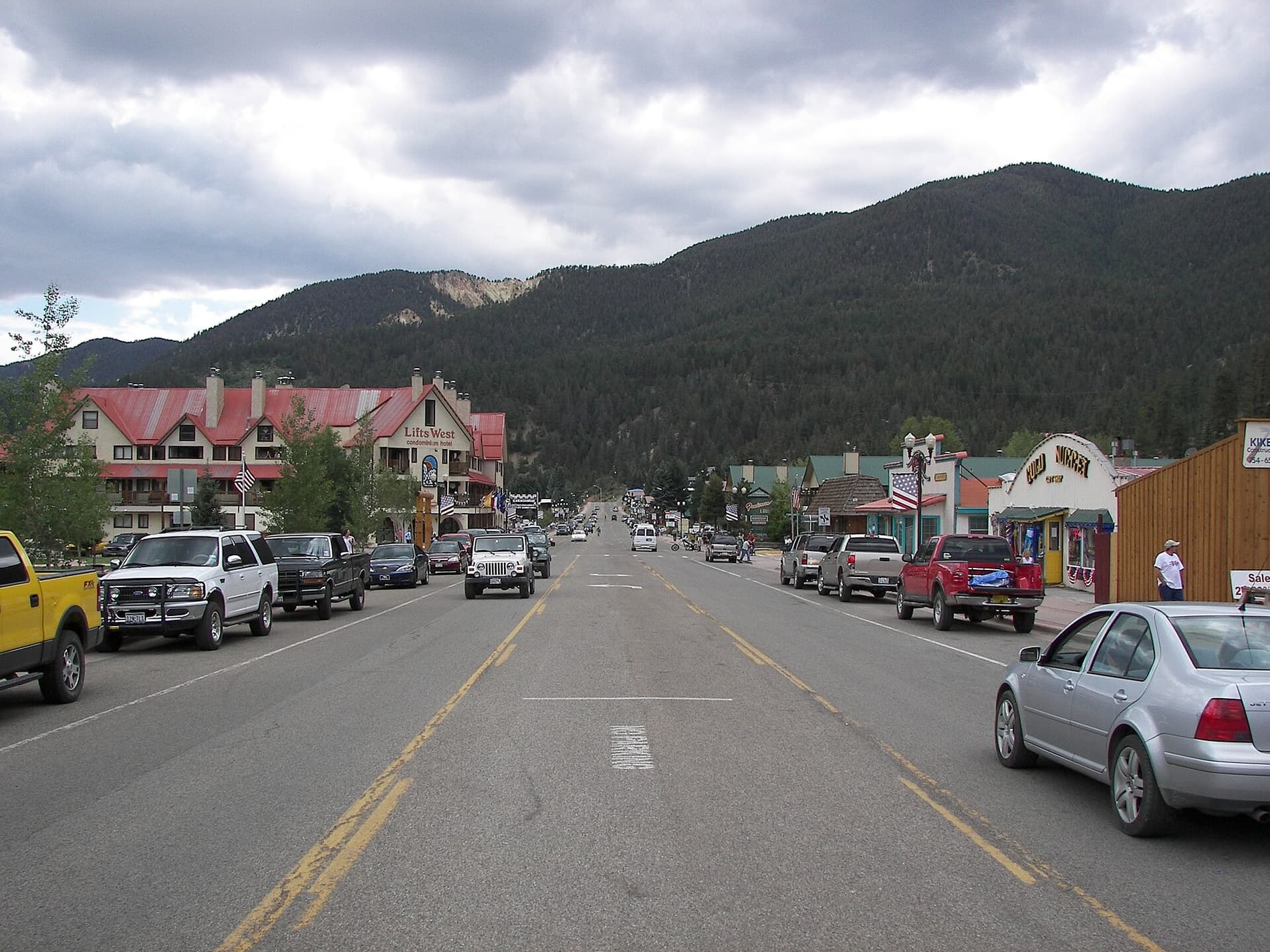
Red River Ski + Summer Area is inseparable from the town around it. The resort describes itself as sitting “smack dab in the middle” of Red River and calls the community a real ski town built by miners rather than developers. State tourism makes the connection concrete: Main Street doubles as a ski run, and most lodging is steps from the lifts. This is a mountain where choosing the town also chooses the base area.
Official statistics place both the town and ski base at 8,750 feet, with a 10,350-foot summit and 1,600 feet of vertical. Seven lifts serve 285 skiable acres and 64 trails. The lift count consists of five chairs and two carpets; the chairs are named Gold, Platinum, Copper, Emerald, and Silver. Two terrain parks add a separate freestyle option.
The trail mix is 31% easier, 31% more difficult, and 38% most difficult. That distribution gives beginners and intermediates equal shares while leaving the largest single category to advanced terrain. The resort and state tourism emphasize a family atmosphere and ski school, but the terrain percentages make clear that the mountain is not exclusively gentle.
Average annual snowfall is 214 inches. Snowmaking covers 85% of the terrain through a system of 102 guns supplied from Base Camp ponds to what the resort calls its Snowflake Factory. Red River describes it as the state’s most powerful snowmaking system; that is the operator’s claim, not an independent ranking. Snowmaking coverage supports operations but cannot settle the daily trail count or season length by itself.
Getting there
The base address is 400 Pioneer Road in Red River, on the Enchanted Circle. From Albuquerque, the resort’s route follows I-25 to Santa Fe, US-285 and NM-68 toward Taos, NM-522 north to Questa, and NM-38 east into town. It publishes a distance of 169 miles but not a drive time, so this guide does not calculate one.
NM-38 also approaches from the east over Bobcat Pass, which town tourism describes as the state’s highest mountain road. Neither the resort nor the town publishes a universal chain or four-wheel-drive requirement for either approach. Use NMRoads for current advisories instead of treating the absence of a blanket rule as an indication of clear pavement.
Once in town, the free Miners Transit shuttle provides an alternative to moving a car between lodging and local stops. The town-integrated layout may also put lodging within steps of the lifts. At 8,750 feet, Red River’s own visitor guidance says the altitude can take a day or two to get used to, an important timing consideration when arriving from lower elevation.
Season & conditions
Red River states a clear operating policy: open the day before Thanksgiving each year, then run daily from December through late March. For 2025–26, opening day was November 26, 2025. The official material describes the end only as late March, so a more specific closing date is not stated here.
No 2026–27 dates had been announced by July 21, 2026. The day-before-Thanksgiving policy offers a planning pattern, not a confirmed future date or snow guarantee. Red River reports more than 300 days of sunshine and November-through-March averages of 39°F for the high and 11°F for the low. Those resort figures describe climate, not the temperature or surface on a selected day.
Evening tubing is another condition-dependent operation. The resort tubing page describes one-hour sessions beginning at 4:30 p.m. and a minimum height of 42 inches. Because that schedule is seasonal, verify the current calendar instead of building a trip around prior-year hours.
Is Red River a good ski resort?
Red River has 285 acres, 1,600 feet of vertical, seven lifts, and a 10,350-foot summit. Its distinguishing feature is the ski-in town at the base, where Main Street doubles as a ski run and most lodging is steps from the lifts. That layout can suit a trip centered on a compact mountain with the town, lodging, and lifts close together. Whether Red River fits depends on the trip.
How much does it cost to ski in Red River, New Mexico?
The resort publishes its rates, and they vary by date, age, and product through the season, so this guide does not reproduce a figure that would go stale. Check Red River’s official site for the rate that applies to the day you plan to ski.
Is Taos or Red River better?
Taos Ski Valley has 3,131 feet of vertical across 1,294 acres on 13 lifts. Red River has 1,600 feet of vertical across 285 acres on seven lifts. Taos is the larger and steeper mountain by those figures, while Red River’s distinguishing feature is that the town sits at the base.
Taos suits a trip centered on more terrain and vertical. Red River suits a trip that places Main Street, lodging, and lifts together. The choice depends on the trip.
Know before you go
The ski area opened in December 1959. Oklahoma businessman Stokes E. Bolton and his wife, Billie, founded it using lift towers fabricated from surplus oil-derrick steel. Drew Judycki became sole owner in 1998; after his death in 2008, the area remained family-owned and has been managed by his son Linton. That history supports the resort’s family-owned identity without stretching it into a claim about who visits.
Red River sells Platinum and Weekender passes. Platinum holders automatically receive Freedom Pass participation, which the resort describes as three free days at each of roughly 20 partner resorts without blackouts and more than 70 reciprocal days in total. The partner list is volatile, so the current pass page, not the approximate count, should guide a multi-resort plan.
Other winter recreation is distributed around town rather than folded into the downhill ticket. Snowmobile routes include groomed trails up Sawmill Canyon toward 11,249-foot Greenie Peak and a 50-mile Valle Vidal loop; a New Mexico off-highway vehicle permit is required. Enchanted Forest, three miles east, is independently owned and promotes 33 kilometers of groomed cross-country and snowshoe terrain. It could not open for groomed skiing during 2025–26 because of low snow and trees lost in a windstorm, while also signaling an ownership transition. Treat it as a separate, status-sensitive plan.