
Hiking Trails
Alkali Flat Trail
Alkali Flat Trail is a strenuous 5-mile loop across soft gypsum dunes with no shade, water, or reliable footprints. Navigation posts, a one-gallon water minimum, the 85 F cutoff, sunset gates, and missile closures define the safe plan.
Official trail information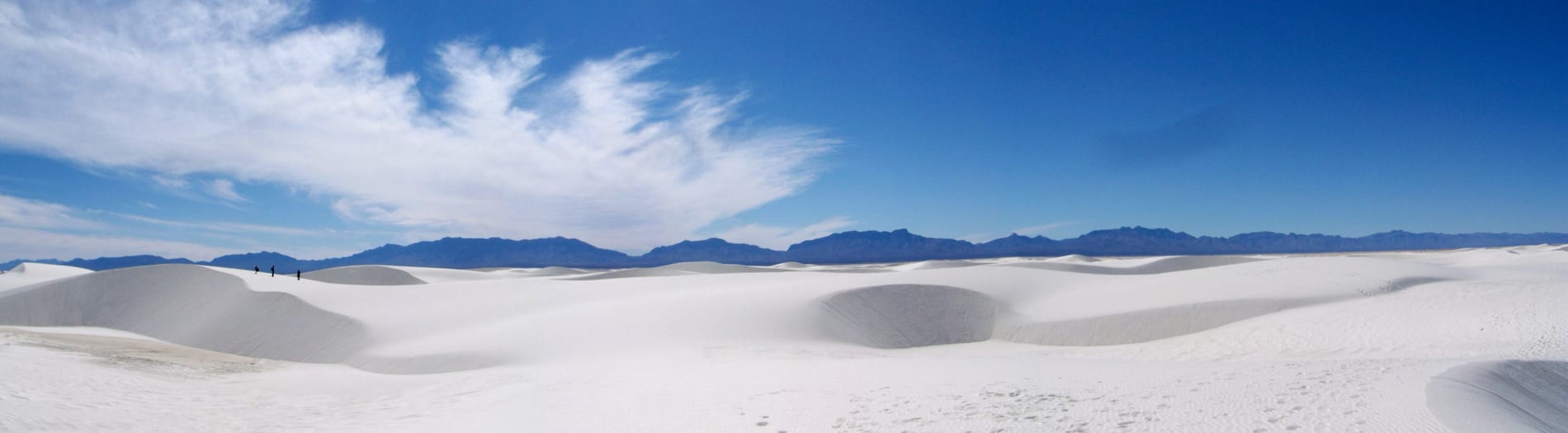

At a glance
- Distance
- 5-mile loop
- Difficulty
- Strenuous
- Typical time
- 3 to 4 hours
- Nearest town
- Alamogordo
Before you goFar end of Dunes Drive, about 7 miles from the visitor center
The Alkali Flat Trail at White Sands is a 5-mile, 8 km loop across continuous soft-sand dune climbs. It has little vegetation and no shade. The National Park Service calls it the park’s most strenuous trail and gives an average completion time of three hours. Plan for 3 to 4 hours.
The route reaches Alkali Flat, the dry lakebed of Ice Age Lake Otero. The lake once covered about 1,600 square miles. The trail’s payoff is the transition from moving dunes to the hard white playa, but reaching it safely depends on marker visibility, water arithmetic, and the temperature at the start.
Navigate from red post to red post
Red posts marked with a diamond show the route. The National Park Service rule is direct: if you cannot see the next marker because of blowing sand or a downed post, do not proceed, return to your car.
GPS is unreliable in the park. Footprints are not a route because wind erases them. Keep the next red post in sight before leaving the current one, and turn around when that chain breaks.
Carry the gallon and obey the temperature cutoff
Carry at least one gallon of water per person per day. The National Park Service says hikers will need more water than they think. When half the water is gone, go back.
Do not start the trail when the temperature is 85 F or higher. Summer afternoons regularly rise above 100 F. There is no water, shade, or toilet along the route. Two vault toilets are available at the trailhead.
Be off the trail by sunset and avoid hiking alone. Rangers respond to dozens of search-and-rescue incidents each year, most involving heat.
In August 2015, two visitors died from heat exposure on this trail during a 101 F afternoon. Their nine-year-old child survived because the parents gave him their remaining water. The group carried about 40 ounces between three people against the National Park Service minimum of one gallon per person. The danger here is arithmetic, not drama: carry the gallon.
Dunes Drive controls the access window
The trailhead is at the far end of Dunes Drive, about seven miles from the visitor center. Dunes Drive opens at 7 am and closes around sunset, so the gate schedule caps both start and finish times.
Missile tests can close Dunes Drive for up to about three hours with short notice. A road closure also closes access to the trailhead. Check the White Sands closures page or call 575-479-6124 on the morning of the hike.
Trail rules
Pets are allowed on a leash no longer than six feet. Carry water for them. The route is for foot travel only.
White Sands Missile Range surrounds the park. If suspected unexploded ordnance appears along the route, do not touch it. Report it to a ranger.
Winter is milder, not risk-free
Milder temperatures make winter the saner season for this exposed hike. Winter days are also short, and the sunset exit still applies. The water minimum, visible-marker rule, closure check, and turnaround point do not disappear with cooler weather.
Practical answers
Questions people ask
How hard is Alkali Flat Trail really?
It is the park's most strenuous trail: a 5-mile loop with continuous soft-sand dune climbs, little vegetation, no shade, and a 3 to 4 hour planning window.
How much water should I carry?
Carry at least one gallon per person per day, and turn back when half of that water is gone. There is no water on the trail. Water is available only at the White Sands visitor center.
Can I hike Alkali Flat Trail in summer?
Do not start when the temperature is 85 F or higher. Summer afternoons regularly exceed 100 F. A cooler morning still requires a gallon of water per person, marker-to-marker navigation, and enough time to leave before sunset.
Source record
Facts checked
Access, fees, closures and operating dates change. Check the linked source before you travel.